
VUEWAY®
(gadopiclenol)
injection
VUEWAY® injection is the new Bracco contrast agent, with the highest relaxivity of all GBCAs today combined with high stability,4 making effective MRI contrast enhancement possible at half the gadolinium dose.*1-3
*Half the gadolinium dose compared to gadobutrol at a standard recommended gadolinium dose of 0.1 mmol/kg in approved indications.
Molecule and Physiochemical properties
The chemical structure of gadopiclenol allows for a high r1 relaxivity by influencing three main parameters: inner and outer sphere coordination sites and tumbling rate.1,4
The large molecule size leads to a lower tumbling rate, which is the reason for higher relaxivity compared to previously approved GBCAs.
Relaxivity (r1 or r2) is the extent to which a contrast agent can increase the relaxation rate of tissue water (1/T1 or 1/T2).

Inner sphere coordination
The structure of gadopiclenol permits the coordination of two water molecules in the inner sphere (q=2) versus one water molecule for the other GBCAs (q=1).
The inner sphere relaxivity is directly proportional to the number of water molecules coordinated with the gadolinium ion. Thus, q=2 in gadopiclenol contributes to increase the relaxivity.

Tumbling rate
Gadopiclenol has a large molecule size due to 3 hydrophilic polyalcohol pendant arms, which reduce rotational diffusion and leads to a lower tumbling rate.

Outer sphere coordination
Gadopiclenol was designed with 3 hydrophilic polyalcohol side chains to increase the number of water molecules bound through the outer coordination sphere mechanism.
Indications
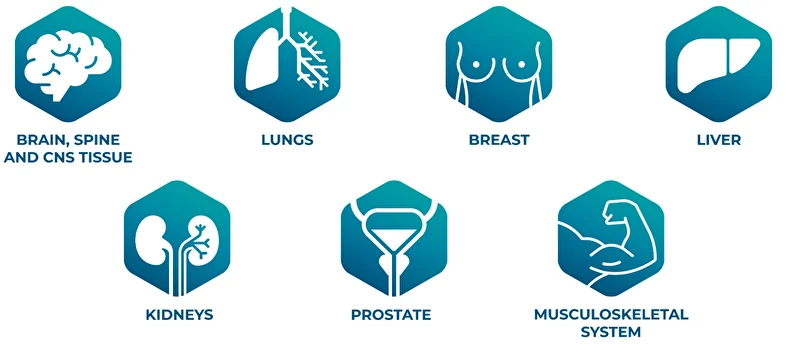
VUEWAY® injection is indicated in adults and children aged 2 years and older for contrast enhanced Magnetic Resonance Imaging (MRI) to detect and visualize lesions with disruption of the blood-brain-barrier (BBB) and/or abnormal vascularity in:
- the Central Nervous System (CNS), i.e., brain, spine and surrounding tissues,
- the Body (head and neck, thorax including breast, abdomen including liver and kidneys, pelvis including prostate, and musculoskeletal system).
It should be used only when diagnostic information is essential and not available with unenhanced MRI.1
VUEWAY® injection, developed with Bracco’s scientific expertise, reflects our commitment to advancing MRI by delivering innovative contrast agents designed to shape the future of prevention and improve patients’ lives. Watch this video to see how VUEWAY® injection is redefining the MRI contrast experience.
References
1. VUEWAY® (gadopiclenol) solution for injection, 485.1 mg/mL. Product Monograph. BRACCO IMAGING Canada. Montreal, QC; April 2026.
2. Loevner L, et al. Invest Radiol. 2023;1;58(5):307-313.
3. Kuhl C, et al. Radiol. 2023;308(1).
4. Robic C, et al. Invest Radiol. 2019;54:475-484.
5. Lancelot E, et al. Invest Radiol. 2020;55(9):578-588.
6. Spinazzi et al., Invest Radiol. 2025, 10.1097/RLI.0000000000001144.
7. Jurkiewicz E, et al. Invest Radiol. 2022;1;57(8):510-516.
8. Brünjes R, Hofmann T. Water Research 2020;182:115966.
Indications/Clinical Use:
VUEWAY® (gadopiclenol) is indicated in:
- adults and children aged 2 years and older for contrast enhanced Magnetic Resonance Imaging (MRI) to detect and visualize lesions with disruption of the blood-brain-barrier (BBB) and/or abnormal vascularity in:
- the Central Nervous System (CNS), i.e., brain, spine and surrounding tissues,
- the Body (head and neck, thorax including breast, abdomen including liver and kidneys, pelvis including prostate, and musculoskeletal system).
Most serious warnings and precautions:
- Nephrogenic Systemic Fibrosis (NSF): Gadolinium-based contrast agents (GBCAs) increase the risk for NSF in patients with chronic severe renal impairment (glomerular filtration rate <30 mL/min/1.73m2), or acute renal failure/acute kidney injury. NSF may result in fatal or debilitating systemic fibrosis affecting the skin, muscle, and internal organs.
- Intrathecal administration of GBCAs can cause serious, life-threatening, and fatal reactions. VUEWAY is not approved for intrathecal use.
Other relevant warnings and precautions:
- Accumulation of Gadolinium in the Brain
- Extravasation and Injection Site Reactions
- Seizures: Patients should be monitored during and following administration
- Renal: VUEWAY should be used with caution in patients with renal impairment
- Acute kidney injury: The risk of acute kidney injury may increase with increasing dose of the contrast agent
- Sensitivity/Resistance
- Skin: The fibrosis associated with NSF can extend beyond dermis and involve subcutaneous tissues, striated muscles, diaphragm, pleura, pericardium, and myocardium
- Pregnancy: The safety of VUEWAY during pregnancy has not been established
- Breastfeeding: It is unknown whether VUEWAY is excreted in human breast milk
For more information:
Please consult the VUEWAY Product Monograph on Health Canada’s website for important information relating to patient selection, adverse reactions, drug interactions, and dosing/administration information, which have not been discussed in this piece. The Product Monograph is also available by calling 1-800-465-5820.
FAIR BALANCE
Indications/Clinical Use:
VUEWAY® (gadopiclenol) is indicated in:
- adults and children aged 2 years and older for contrast enhanced Magnetic Resonance Imaging (MRI) to detect and visualize lesions with disruption of the blood-brain-barrier (BBB) and/or abnormal vascularity in:
- the Central Nervous System (CNS), i.e., brain, spine and surrounding tissues,
- the Body (head and neck, thorax including breast, abdomen including liver and kidneys, pelvis including prostate, and musculoskeletal system).
Most serious warnings and precautions:
- Nephrogenic Systemic Fibrosis (NSF): Gadolinium-based contrast agents (GBCAs) increase the risk for NSF in patients with chronic severe renal impairment (glomerular filtration rate <30 mL/min/1.73m2), or acute renal failure/acute kidney injury. NSF may result in fatal or debilitating systemic fibrosis affecting the skin, muscle, and internal organs.
- Intrathecal administration of GBCAs can cause serious, life-threatening, and fatal reactions. VUEWAY is not approved for intrathecal use.
Other relevant warnings and precautions:
- Accumulation of Gadolinium in the Brain
- Extravasation and Injection Site Reactions
- Seizures: Patients should be monitored during and following administration
- Renal: VUEWAY should be used with caution in patients with renal impairment
- Acute kidney injury: The risk of acute kidney injury may increase with increasing dose of the contrast agent
- Sensitivity/Resistance
- Skin: The fibrosis associated with NSF can extend beyond dermis and involve subcutaneous tissues, striated muscles, diaphragm, pleura, pericardium, and myocardium
- Pregnancy: The safety of VUEWAY during pregnancy has not been established
- Breastfeeding: It is unknown whether VUEWAY is excreted in human breast milk
For more information:
Please consult the VUEWAY Product Monograph on Health Canada’s website for important information relating to patient selection, adverse reactions, drug interactions, and dosing/administration information, which have not been discussed in this piece. The Product Monograph is also available by calling 1-800-465-5820.